sustainability
Carbon-negative aggregate drives 40% emissions cut on Oxfordshire resurfacing trial
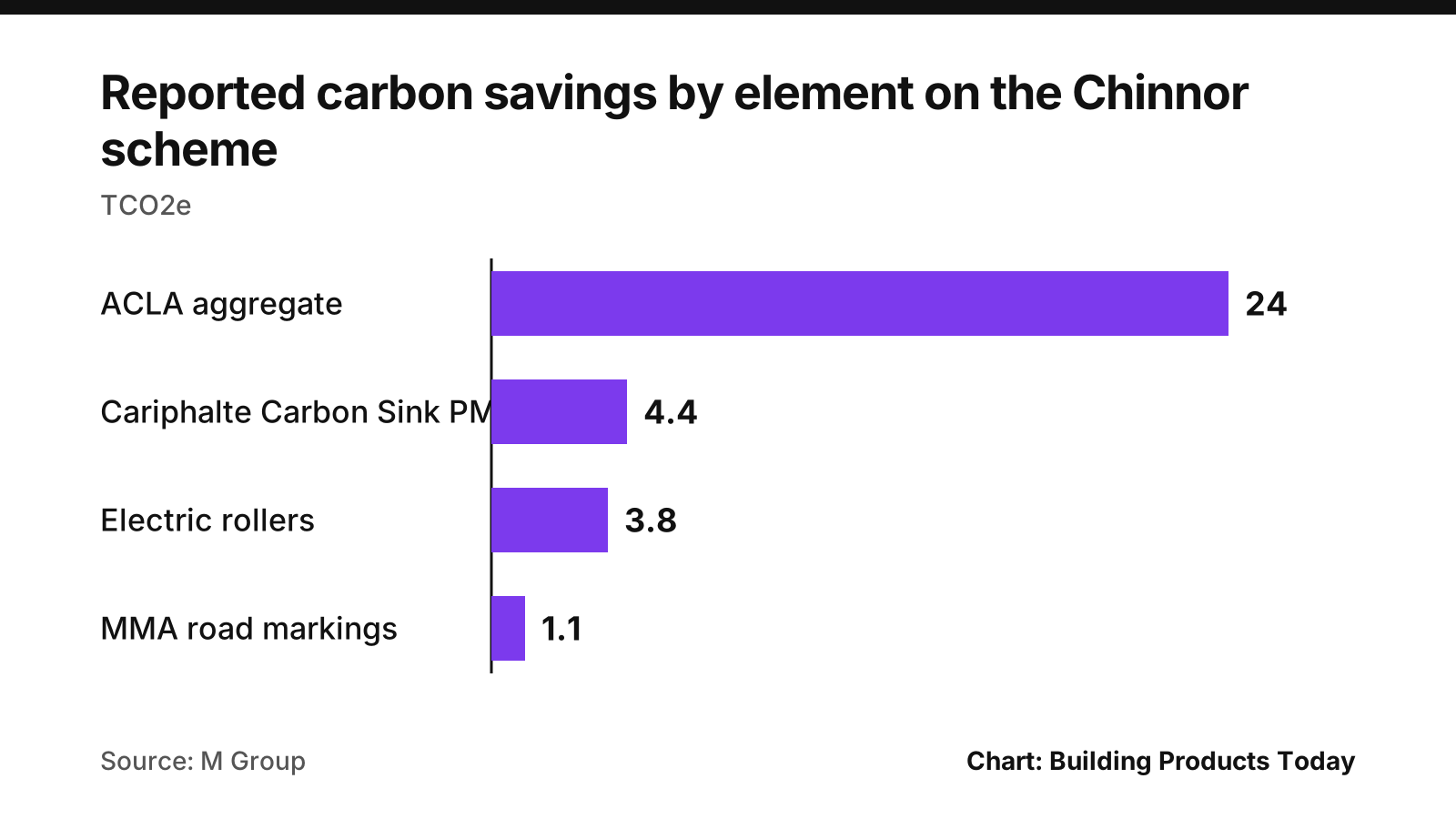
M Group says a 300-metre resurfacing of the B4445 in Chinnor saved about 30 tonnes of carbon, with Low Carbon Materials' ACLA aggregate replacement accounting for around 24 tCO2e of the total.

M Group has reported a carbon saving of about 30 tonnes, a reduction of almost 40%, on a 300-metre resurfacing of the B4445 in Chinnor delivered for Oxfordshire County Council with five supply chain partners.
The contractor said the scheme was the first in Oxfordshire to use ACLA, a carbon-negative aggregate replacement developed by UK firm Low Carbon Materials (LCM). According to M Group, ACLA alone accounted for around 24 tCO2e of the savings, which it described as over two-thirds of the project total.
M Group delivered the work with Breedon, DJT, TSM, FCL and Wilson & Scott Highways. Breedon designed and laid a bespoke asphalt mix incorporating the ACLA material, which M Group said captures carbon dioxide and chemically binds it into the road for more than 100 years.
Dr Natasha Boulding, Low Carbon Materials' CEO and Co-founder, said: "ACLA® goes into the mix at existing asphalt plants and gets laid like any other asphalt, so it's easy for councils and contractors to use."
The product
ACLA's registered Environmental Product Declaration, published through The International EPD System, gives the material an A1-A3 global warming potential of minus 798 kg CO2e per tonne. The EPD states that ACLA replaces natural stone aggregate in asphalt binder course mixes, typically making up 3-10% of the mix.
Oxfordshire County Council said before the works that the ACLA binder course was a bespoke mix developed specifically for the Chinnor scheme and was expected to deliver the largest saving of the package.
LCM spun out of Durham University in 2019 and was founded by Natasha Boulding, Scott Bush and Phil Buckley, according to the university. Its net zero asphalt material was first used on a resurfacing scheme at Elvet Hill in Durham in March 2024 with Durham County Council and Rainton Construction.
The other savings
M Group set out the contribution of each element of the scheme. Shell Cariphalte Ultra Carbon Sink polymer modified bitumen saved about 4.4 tCO2e, and cold-applied MMA (methyl methacrylate) road markings installed by Wilson & Scott Highways contributed a further 1.1 tCO2e.
| Element | Saving (tCO2e) |
|---|---|
| ACLA aggregate replacement | 24 |
| Shell Cariphalte Ultra Carbon Sink PMB | 4.4 |
| Electric rollers | 3.8 |
| MMA road markings | 1.1 |
The MMA markings cure through a chemical reaction without heating, which M Group said gives a lower carbon footprint than thermoplastic markings and removes the risks of heating material to around 200°C.
Electric rollers used during construction saved about 3.8 tCO2e against diesel alternatives, M Group said. The council's pre-works announcement said electric plant on the scheme was used by sub-contractors Breedon and DJT, with solar-powered welfare cabins and traffic management provided by TSM Ltd.
The council's September release also listed Thermal Joint Heating technology for asphalt joints among the innovations; M Group's results release does not mention it and gives no saving for it.
Richard Lovewell, M Group's Business Director, said: "This enables us to evaluate how they perform together in real-world conditions and generate learning that could influence future schemes across the industry."
Forecast against outcome
Before the works, Oxfordshire County Council said the package of five complementary innovations was expected to cut embodied carbon by more than 30 tonnes of CO2 equivalent compared with conventional resurfacing. M Group's reported figure of about 30 tonnes is provisional: it said final savings will be confirmed once a full as-built assessment is completed later in November.
The resurfacing and new road markings were carried out under a full road closure in the week of 28 September to 2 October 2026, with drainage and verge works in two further phases either side, according to the council. Councillor Liz Leffman, who holds the council's highways construction and repair cabinet portfolio, said before works began that the trial was also examining durability and long-term maintenance, not only carbon.
Victoria Rand, Commercial Manager at Breedon Surfacing Solutions, said sharing what is learnt from the scheme would help build confidence in lower-carbon approaches and support their use on future projects.
M Group describes itself as an infrastructure services business working across water, energy, transport and telecoms with more than 14,000 people and a heritage of more than a century. The as-built carbon assessment for Chinnor is due before the end of November.
On the record: M Group, Oxfordshire County Council
Sources
- M Group (opens in a new tab) (accessed 2026-11-20)
- Oxfordshire County Council (opens in a new tab) (accessed 2026-11-20)
- EPD International (The International EPD System) (opens in a new tab) (accessed 2026-11-20)
- Durham University (opens in a new tab) (accessed 2026-11-20)
- M Group (opens in a new tab) (accessed 2026-11-20)
This story was researched from the primary sources above and checked against them before publication. Spotted an error? Tell us and we will correct it promptly.