specification
NFRC tells roofers to plan for NHBC flat roof testing rules ahead of 2027 start
The roofing trade body has urged contractors on NHBC-registered homes to build inspection and integrity testing of flat roofs, terraces and balconies into design, procurement and programme before the guidance bites.
The National Federation of Roofing Contractors (NFRC) has told roofing contractors working on NHBC-registered homes to prepare now for inspection and testing requirements covering flat roofs, terraces and balconies on homes started in 2027.
The requirements come from NHBC Technical Guidance 7.1/04, titled Verification and testing for flat roofs, terraces and balconies and dated June 2026, which NFRC said sets out how waterproofing should be inspected, tested and verified.
NFRC said in its 5 November alert that the requirements apply to relevant NHBC projects across the UK and are not a universal statutory testing requirement for all flat roofs.
The trade body's central message was that verification should be planned at design and procurement stage. It said testing arrangements can affect the roof specification, access, programme and cost, including whether a conductive layer or other provision is needed, and that these decisions should be settled before materials are ordered.
What the guidance requires
According to NFRC, the guidance distinguishes between roof types, sizes and building heights.
Traditional flat roofs, terraces and balconies over habitable space that are below 50 square metres, on buildings of one to three storeys and with minimum falls of 1:80, require visual inspection and quality assurance records.
Similar roofs below 50 square metres on buildings over three storeys require both visual inspection and waterproofing integrity testing, NFRC said, as do traditional roofs over 50 square metres.
Green, brown and blue roofs require visual inspection and integrity testing regardless of size, and so does waterproofing laid to zero falls. Verification arrangements for complex geometry, interfaces or combinations of waterproofing materials should be agreed with NHBC for each site.
NFRC said the 50 square metre threshold should therefore not be treated as a blanket exemption. Where electronic testing is unsuitable, it said, Note 2 of the guidance provides for suitably qualified visual inspection, including seam probing where applicable.
Responsibilities and records
NFRC said contractors should establish which requirements apply to their project and agree responsibilities with the designer, waterproofing manufacturer and principal contractor. Inspection and independent third-party testing, where required, should be programmed before finishes conceal the waterproofing.
Records should identify the inspected and tested areas, methods used, limitations, defects, repairs and any retesting, supported by photographs and testing documentation, the trade body said.
It added that a manufacturer's decision not to require leak testing for its guarantee does not remove applicable NHBC verification requirements. "Equally, integrity testing supplements correct installation, supervision and quality assurance; it does not replace them," NFRC said.
The 2027 Standards
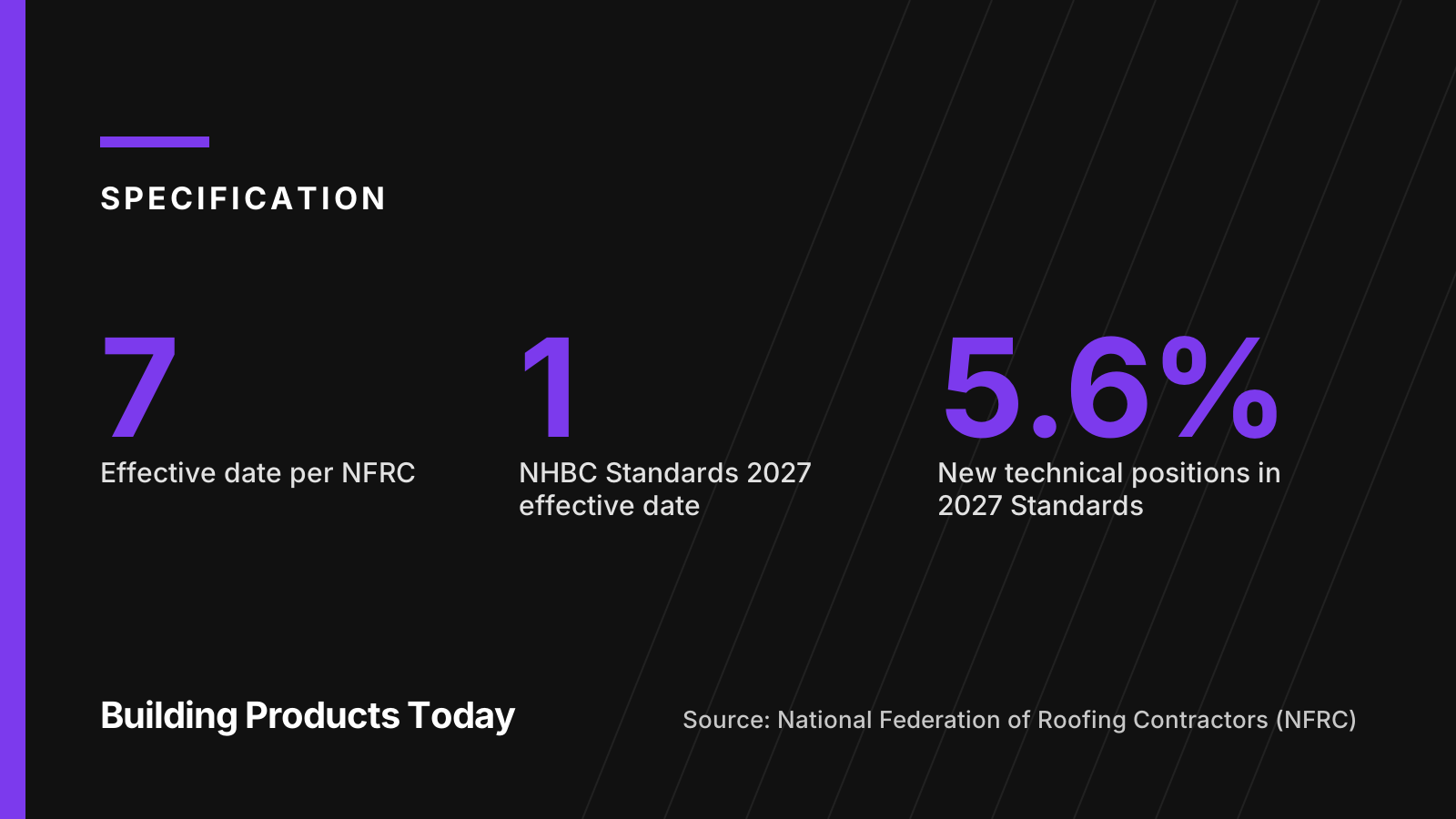
NFRC's article says the flat roof verification requirements in Technical Guidance 7.1/04 apply to homes where foundations begin on or after 7 February 2027.
The alert came three days after NHBC announced, on 2 November, the 2027 edition of its Technical Standards. NHBC's standards page says the NHBC Standards 2027 take effect for NHBC-registered homes where foundations are begun on or after 1 January 2027, following the same convention as the 2026 edition, which applied from 1 January 2026.
NHBC's 2027 announcement did not highlight flat roofs, balconies or terraces. It said only 5.6% of clauses in the new edition introduce a new technical position, and that the edition adds a new chapter, 3.4 Coastal Locations.
Alexis Stickley, Standards and Technical Manager at NHBC, said: "NHBC's purpose is to raise standards in house building by championing high-quality homes and protecting homeowners."
NHBC describes its Standards as defining the technical requirements and performance standards for the design and construction of new homes, and as guidance on the requirements for achieving NHBC warranty and insurance. Its Standards, technical news and Technical Guidance Notes are available only to registered builders and developers and their professional partners, who must register to log in.
NFRC, established in 1892, describes itself as the largest roofing trade association in the UK, with a membership of specialist roofing contractors, manufacturers and distributors.
It has advised contractors to consult the full NHBC guidance, on pages 2 to 5 of Technical Guidance 7.1/04, alongside the project specification.
On the record: NHBC
Sources
- National Federation of Roofing Contractors (NFRC) (opens in a new tab) (accessed 2026-11-06)
- NHBC (opens in a new tab) (accessed 2026-11-06)
- NHBC (opens in a new tab) (accessed 2026-11-06)
- NHBC (opens in a new tab) (accessed 2026-11-06)
- NHBC (opens in a new tab) (accessed 2026-11-06)
- National Federation of Roofing Contractors (NFRC) (opens in a new tab) (accessed 2026-11-06)
This story was researched from the primary sources above and checked against them before publication. Spotted an error? Tell us and we will correct it promptly.