certification
NFRC sets out what construction products reform means for manufacturers and merchants
The roofing trade body has compared the government's 18 November response to the Construction Products Reform White Paper with its own May submission, flagging unsettled questions on liability, timing and regulator resourcing.
The National Federation of Roofing Contractors (NFRC) has told members that the government's response to the Construction Products Reform White Paper, published on 18 November, confirms the direction of reform but leaves liability, testing capacity and timing unsettled.
In a briefing published on 27 November, NFRC said the government plans to legislate from 2027, phase the changes in and move the regulator's role into a new single construction regulator over time.
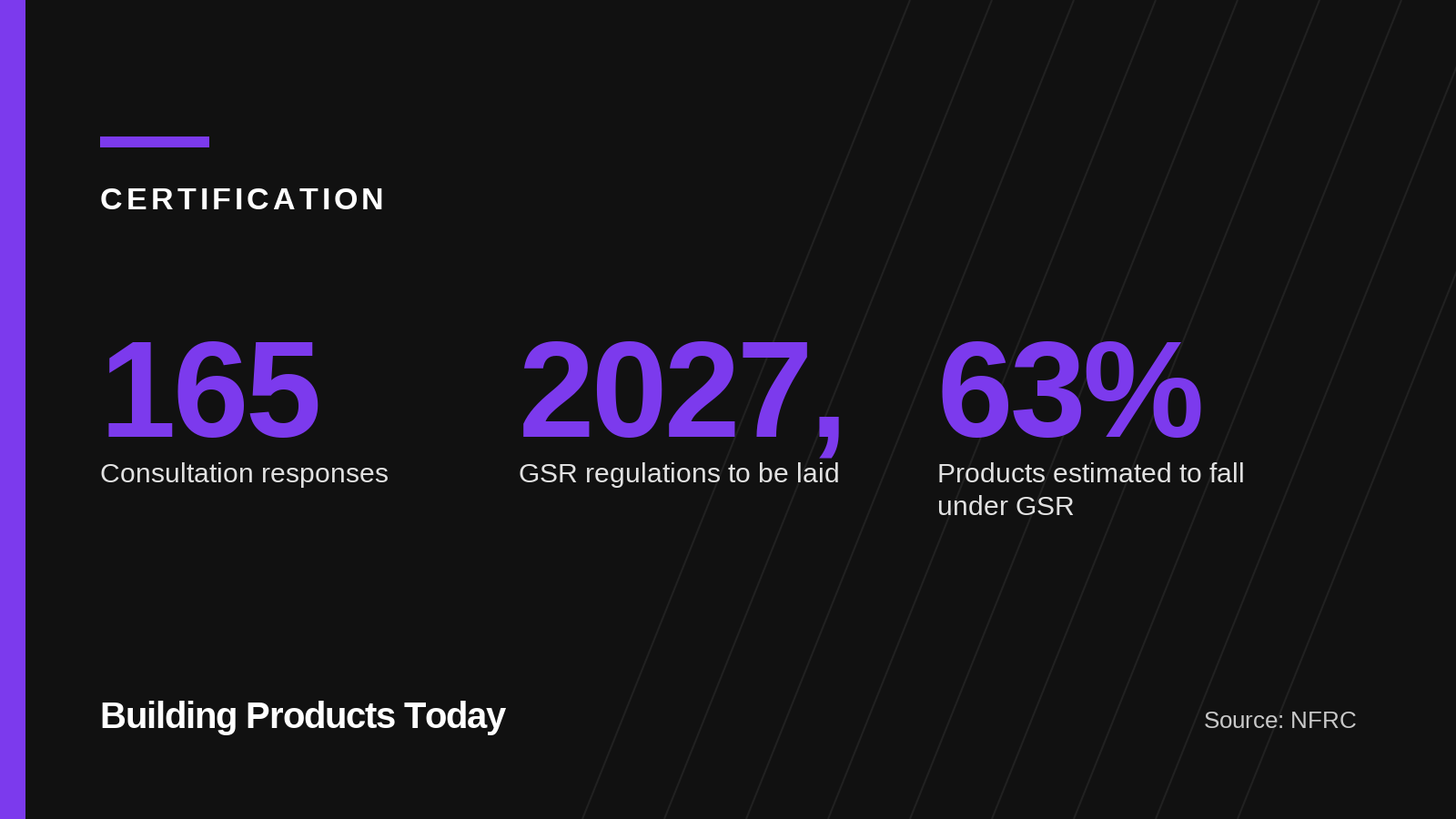
The Ministry of Housing, Communities and Local Government (MHCLG) said the white paper consultation ran for 12 weeks, from 25 February to 20 May 2026, and received 165 responses.
Baroness Blake of Leeds CBE, Parliamentary Under Secretary of State (Lords), said in the foreword to the response: "Construction products reform is a critical pillar of this system-wide change."
What the government has confirmed
MHCLG said it does not currently intend to establish a fixed statutory list of products critical to safe construction. It will instead review Building Regulation 7(1) of the Building Regulations 2010.
NFRC said products with a designated standard or technical assessment will stay under the construction products regulations (CPR), while all other products will come under the General Safety Requirement (GSR). A product sits under one regime or the other, not both, and the regulator can remove unsafe products under either.
All UK conformity assessment bodies (CABs) will need a licence from the national regulator. MHCLG said the licensing regime will be mandatory and based on the principles of competence, independence, transparency and proportionality.
The national regulator for construction products will be recognised as a prescribed whistleblowing body, MHCLG said. It also said it remains committed to establishing new public sector testing and research capacity, and that the single construction regulator will ultimately oversee construction products regulation.
Timetable
MHCLG said it intends to lay the GSR regulations in 2027 and give businesses at least a 12-month implementation period. In its companion response to the GSR consultation, the department said respondents generally showed strong support, with most proposals receiving over 60% agreement.
NFRC's reading of that timetable is that the earliest GSR start is 2028 rather than late 2027. The trade body said that was an improvement, but not the late 2028 it had asked for.
NFRC had also said guidance on critical products must be published at least 12 months before obligations come into force. MHCLG committed to guidance being available sufficiently ahead of commencement, without setting a fixed lead time.
Where NFRC's position was met
In its May 2026 submission, NFRC argued that end-use application and failure risk to life, rather than product category, should determine whether a product is critical. It said the government has agreed with that approach.
NFRC's own members were divided, however. Asked whether all roofing and cladding components should be treated as critical, about 50% said yes, 20% said no and the rest were unsure. NFRC said it will watch how the end-use approach works in practice.
The trade body said it had backed a mandatory CAB licensing regime and legal protection for whistleblowers, both of which are now confirmed.
Outstanding concerns
NFRC said regulator resourcing must be a precondition for reform. It said the government's response makes no specific funding commitment, saying only that costs will be proportionate and capacity will be central to delivery.
On liability, NFRC said the review of Regulation 7(1) will look at the duties of specifiers, designers, contractors and installers, and could place new duties on contractors. NFRC has called for mandatory installer competency to be reflected in the review.
NFRC said its engagement on the white paper included meetings and a webinar attended by MHCLG representatives, with more than 80 members taking part.
What it means for manufacturers and merchants
In an earlier explainer on the GSR, NFRC said the government estimates that around 63% of all construction products are not covered by a designated standard and will fall under the new requirement.
Under the GSR, manufacturers must complete a written risk assessment before placing a product on the market and keep records for 10 years, NFRC said. Merchants and distributors will have to check that the manufacturer has completed that assessment.
NFRC's advice to manufacturers and merchants is to check whether products have a designated standard or technical assessment, and to review test evidence and product information. For contractors, it said nothing changes today: follow manufacturers' installation instructions and document and approve any product substitution.
MHCLG said it intends to lay the GSR regulations in 2027.
On the record: Ministry of Housing, Communities and Local Government
Sources
- NFRC (opens in a new tab) (accessed 2026-11-27)
- Ministry of Housing, Communities & Local Government (opens in a new tab) (accessed 2026-11-27)
- Ministry of Housing, Communities & Local Government (opens in a new tab) (accessed 2026-11-27)
- NFRC (opens in a new tab) (accessed 2026-11-27)
- NFRC (opens in a new tab) (accessed 2026-11-27)
This story was researched from the primary sources above and checked against them before publication. Spotted an error? Tell us and we will correct it promptly.